
Tag: Sam Crawford

A True Test of AI’s Predictive Power
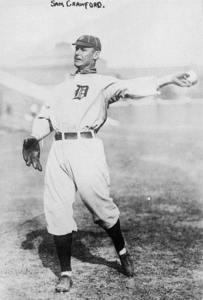 Only recently has it become axiomatic that AI will transform the fields of health and science, business and finance, and even outer space travel. And yet some question—as I do—whether AI can assist in solving some of the most pressing challenges facing our times, such as settling long-standing debates among baseball savants over which records are likely to stand the test of time.
With baseball season well underway, I thought it would be interesting to see whether Google and/or ChatGPT could tell us whether the all-time record of 309 triples held by Samuel Earl Crawford, aka Wahoo Sam, the Detroit Tiger Hall of Famer, is likely to remain enshrined in the record books. I have long believed this achievement will never be eclipsed. Just to be sure, I asked Google and ChatGPT: “Is Sam Crawford’s MLB record for triples likely to be broken?”
Google’s AI generated results begin with the conclusion that Crawford’s record is “virtually unbreakable,” citing modern baseball’s emphasis on home runs and doubles, the fact that during Crawford’s time outfielders played shallower, and that ball parks were often larger. That modern ballparks are smaller than those of the early 1900s surprised me, but consider that the distance from home plate to dead center in the Polo Grounds was 483 feet. This compares to Coors Field, the home of the Colorado Rockies, where the distance from home plate to dead center is 415 feet—the longest among current day MLB ballparks. To bolster its argument, Google cites several sources, including Bleacher Report, Wikipedia, The Baseball Scholar, as well as discussion groups on Quora, among others. An optional deeper dive into Google’s Gemini AI reveals that in 1920 the rate of triples per game was 0.51, versus .16 in 2019. Thus, Google is not only gathering facts, but applying logic and reasoning to its conclusion.
In response to the question at hand, ChatGPT responded: “probably not.” In doing so, it cites the fact that modern ballparks are smaller and more uniform, making it difficult to hit balls into gaps. In addition, advanced defensive positioning strategies give outfielders the ability to guard against extra base hits. This makes sense to me, as it is difficult to imagine either Sam Crawford or teammate Ty Cobb carrying a “cheat sheet” inside their baseball caps to prevent Nap Lajoie from turning a double into a triple. ChatGPT points out that in order for Crawford’s record to be broken, a player would need to hit roughly 20 triples per season for 15 years, citing ESPN and Guinness World Records as sources for these insights, which I found to be particularly compelling.
While noting many of the factors that make it exceedingly difficult to break Crawford’s record, I was, nonetheless, intrigued by ChatGPT’s more tentative conclusion. This seems to be traceable to the recent performance of Corbin Carroll, the Arizona Diamondbacks’ twenty-five year-old outfielder, who in less than four full seasons has already racked up 53 triples, and is on track to lead the National League in the category for the fourth consecutive year. Assuming Carroll finishes this season with 58 triples, it would take an average of 16 triples per year over the next sixteen seasons to exceed Crawford’s total. You can judge for yourself whether this is in the realm of the possible, or whether Carroll has not a prayer to break the record.
Overall, I was impressed by the ability of modern-day AI tools to bolster their arguments by drawing on authoritative sources, as well as applying reasoning and logic to their arguments. I am also impressed by ChatGPT’s ability to adapt to changing dynamics by acknowledging that a player of Carroll’s caliber has at least the potential to challenge the record. I can now better understand the excitement and allure around AI, and its promise for answering some of the more crucial questions and lingering debates among avid baseball fans.