
Year: 2026

ChatGPT Vs. Google: Who Will Win the Race for the Everyday User?

Image credit: Gemini AI
In trying to determine whether newer is better, it’s useful to recall the epic battle between two futuristic robots, or Cyborgs, in the movie Terminator 2: Judgment Day. A first generation terminator, the T-800, played by Arnold Schwarzenegger, is sent back in time to save its creator, and in the process, humanity itself. The T-800 informs us, that its mind is a neural network, coupled with an image processor that enables it to constantly learn from experience and its environment.
A second generation terminator (Robert Patrick) is sent on a parallel mission to confront the T-800. As an advanced prototype, the T-1000 is made of a liquid metal alloy, replete with shape-shifting features that allow it to mimic another person’s appearance and voice, as well as weaponize its own body, all in an attempt to foil and, if possible, destroy the first terminator.
While Google has always been highly secretive about the technology that drives its search results, it has been using machine learning and AI in its search algorithms for many years. Like the T-800, the Google search engine constantly learns and embeds new technologies. Well aware of the threat posed by ChatGPT and other generative AI platforms, Google has dramatically improved its AI features over the last 18 months, and closed the gap by deploying its Gemini AI assistant not only to fine-tune answers to user queries, but also to offer follow-up assistance like ChatGPT.
Like the second generation terminator, which was forced to confront a surprisingly clever adversary, so too has ChatGPT encountered a capable and highly advanced opponent. As each company invests significant capital to enhance its AI features, Google has the advantage of being able to monetize its investments through its highly profitable ad business, as well as its enterprise business, Google Cloud. The question for ChatGPT is whether it can continue to evolve and demonstrate the ability to effectively outsmart a formidable adversary. As a spoiler alert, recall that in the movie the first generation terminator neutralized its opponent by luring it into a vat of molten steel.
In the near-term it is unlikely there will be such a decisive victory by either Google or ChatGPT. In the meantime, everyday computer users will benefit from the spirited competition between the two AI-driven engines.

A True Test of AI’s Predictive Power
 Only recently has it become axiomatic that AI will transform the fields of health and science, business and finance, and even outer space travel. And yet some question—as I do—whether AI can assist in solving some of the most pressing challenges facing our times, such as settling long-standing debates among baseball savants over which records are likely to stand the test of time.
With baseball season well underway, I thought it would be interesting to see whether Google and/or ChatGPT could tell us whether the all-time record of 309 triples held by Samuel Earl Crawford, aka Wahoo Sam, the Detroit Tiger Hall of Famer, is likely to remain enshrined in the record books. I have long believed this achievement will never be eclipsed. Just to be sure, I asked Google and ChatGPT: “Is Sam Crawford’s MLB record for triples likely to be broken?”
Google’s AI generated results begin with the conclusion that Crawford’s record is “virtually unbreakable,” citing modern baseball’s emphasis on home runs and doubles, the fact that during Crawford’s time outfielders played shallower, and that ball parks were often larger. That modern ballparks are smaller than those of the early 1900s surprised me, but consider that the distance from home plate to dead center in the Polo Grounds was 483 feet. This compares to Coors Field, the home of the Colorado Rockies, where the distance from home plate to dead center is 415 feet—the longest among current day MLB ballparks. To bolster its argument, Google cites several sources, including Bleacher Report, Wikipedia, The Baseball Scholar, as well as discussion groups on Quora, among others. An optional deeper dive into Google’s Gemini AI reveals that in 1920 the rate of triples per game was 0.51, versus .16 in 2019. Thus, Google is not only gathering facts, but applying logic and reasoning to its conclusion.
In response to the question at hand, ChatGPT responded: “probably not.” In doing so, it cites the fact that modern ballparks are smaller and more uniform, making it difficult to hit balls into gaps. In addition, advanced defensive positioning strategies give outfielders the ability to guard against extra base hits. This makes sense to me, as it is difficult to imagine either Sam Crawford or teammate Ty Cobb carrying a “cheat sheet” inside their baseball caps to prevent Nap Lajoie from turning a double into a triple. ChatGPT points out that in order for Crawford’s record to be broken, a player would need to hit roughly 20 triples per season for 15 years, citing ESPN and Guinness World Records as sources for these insights, which I found to be particularly compelling.
While noting many of the factors that make it exceedingly difficult to break Crawford’s record, I was, nonetheless, intrigued by ChatGPT’s more tentative conclusion. This seems to be traceable to the recent performance of Corbin Carroll, the Arizona Diamondbacks’ twenty-five year-old outfielder, who in less than four full seasons has already racked up 53 triples, and is on track to lead the National League in the category for the fourth consecutive year. Assuming Carroll finishes this season with 58 triples, it would take an average of 16 triples per year over the next sixteen seasons to exceed Crawford’s total. You can judge for yourself whether this is in the realm of the possible, or whether Carroll has not a prayer to break the record.
Overall, I was impressed by the ability of modern-day AI tools to bolster their arguments by drawing on authoritative sources, as well as applying reasoning and logic to their arguments. I am also impressed by ChatGPT’s ability to adapt to changing dynamics by acknowledging that a player of Carroll’s caliber has at least the potential to challenge the record. I can now better understand the excitement and allure around AI, and its promise for answering some of the more crucial questions and lingering debates among avid baseball fans.
What Berkshire County Can Teach Us about EV Adoption
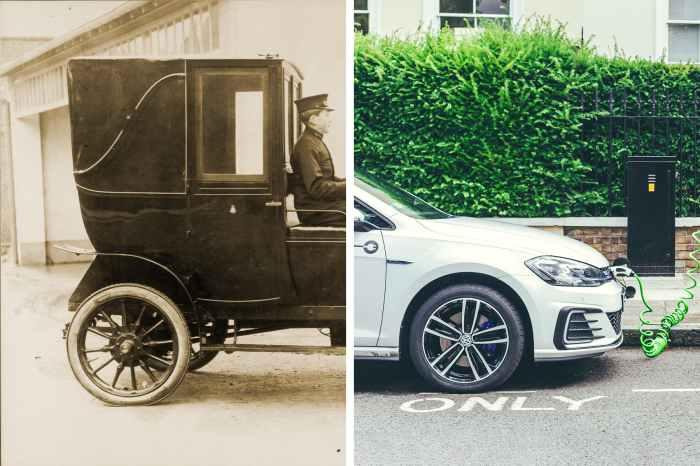
 Lithium battery powered cars were first sold in the U.S. in 2008, roughly 110 years after their gas-powered predecessors debuted on American roads.
Located at the western edge of Massachusetts, Berkshire County is today, as it has always been, a popular place to spend the summer. Banded by Williamstown in the north and Sheffield in the south, the region’s farm and conservation lands conjure up a bygone era, even as the appearance of modern cars and trucks on its roads reminds us of the here and now.
Not surprisingly, I’ve noticed firsthand that electric vehicles from Tesla, Ford, Rivian, and others have crept their way into the Berkshire countryside. EVs currently account for less than seven percent of new car purchases in the U.S.—up from just 2% in 2020. But, thus far, they are embraced primarily by early adopters like those in the Berkshires.
As it turns out, this trend was also true of the Berkshires in the early years of the first automobile revolution. More than 230 manufacturers—including Knox Automobile, Stevens-Duryea, the Packard Motor Company, Olds Motor Works, the Henry Ford Company, and Mercedes Simplex—tested their autos on the roads of Berkshire County in the first 15 years of the 1900s, according to historian Bernard A. Drew. In his insightful study of the early automobile industry, Well Wheeled: How Cortlandt Field Bishop, Marguerite Westinghouse, Alden Sampson II and Gilded Age Lenox Cottagers Fueled the Brass Era of American Automobiling, Drew, himself a Berkshire resident, reaches back in time to the turn of the 20th century, when the barriers to enter the car business were much lower than they are today. Small teams of talented engineers brought their early prototypes to the road, and the well-to-do assumed the risk of patronizing their efforts.
During that period, many of the well-heeled luminaries of the Gilded Age, such as the Sloanes, Morgans, Whartons, and Vanderbilts, spent their summers in the county. Unconstrained by speed limits and licenses, these early auto enthusiasts provide a glimpse into the challenge of moving the first fleet of automobiles into the mainstream.
Edith Wharton, who was among the most successful authors of the era and a Berkshire aristocrat, was also fascinated by the automobile. While taking a break from writing the next chapter of The Age of Innocence, or pondering the plot line for Ethan Frome, she could be seen behind the wheel of her single-cylinder, 10 horsepower 1904 Pope-Hartford, her 24-horsepower Panhard, or one of her many other cars. But she lamented their lack of reliability and her frequent visits to the local mechanic. “One set out on a 10-mile run with more apprehension than would now attend a journey across Africa,” she observed. There was, however, an “inexhaustible delight in penetrating to the remoter parts of Massachusetts” from behind the wheel.
It wasn’t until Ford launched the Model T in 1908 that the automobile became easier to operate—it introduced a simpler 2-speed manual gearbox—and became affordable for many, thanks to mass production. Model T annual sales increased from 10,000 in its debut year to more than 300,000 by 1914.
As was the case during the first automobile revolution, early EV models from Tesla, Porsche, and BMW were typically priced in excess of $80,000, and embraced primarily by well-heeled auto enthusiasts. But in just 15 years, the market is already entering its Model T era: EVs have begun to close the price gap with gas-powered cars. According to Cox Automotive the average EV is priced at $6,200 above the average price of a gasoline powered car. The gap would be considerably narrower, but for the cancellation of EV tax credits enacted under the Affordable Care Act.
Undeniably, more is needed to appeal to those still reluctant to take the EV plunge. Faster charging, greater availability of public charging stations, longer driving range, better cold weather performance, as well as even more affordable models will help to close the gap. Advances in autonomous driving will also give EVs another leg up over gas-powered cars.
While the Model T revolutionized personal transportation in the U.S., the horse and buggy was still a common mode of transportation through the Great Depression, particularly in rural areas. It took roughly 30 years after their commercial debut for autos to become ubiquitous on American roadways.
The U.S. is less than two decades into the EV revolution. There is still plenty of time for EVs to mature and demonstrate their advantages over the internal combustion engine created more than one hundred years ago.
Please note that an earlier version of this Op-Ed, written by Ben Z. Rose, president of Battle Road Research, appeared in Barron’s.
IMAGE CREDIT: ILLUSTRATION BY BARRON’S; GETTY (1), DREAMSTIME (1)
Electric Vehicles: an Industry Still in its Infancy
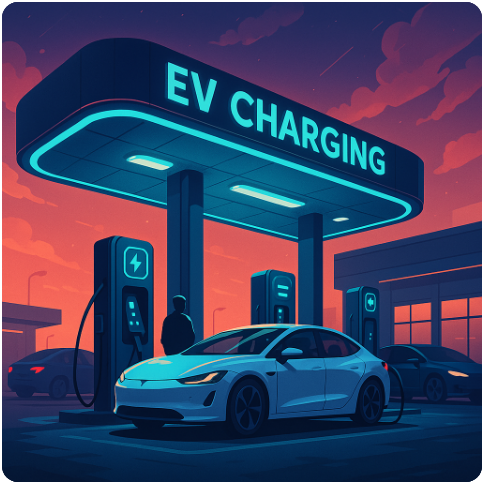
 The electric vehicle (EV) market is still in its early stage of adoption. Cars manufactured with internal combustion engines, drawing on an approach pioneered over 140 years ago by Karl Benz, continue to dominate the world’s highways and byways. And Yet, virtually every automotive manufacturer in the world is pursuing a variety of strategies to address the market, in an effort to embrace new technology, meet consumer demand, as well as comply with government regulators, who –for the most part—continue to pressure the industry to achieve better mileage standards, and reduce carbon emissions.
What began as a trickle with a lone, two-seat sports car introduced by Tesla Motors in 2006, EVs have become the fastest growing segment of the global transportation industry. Legacy manufacturers of internal combustion engine cars and trucks including General Motors, Ford Motor Company, Stellantis, Mazda, Porsche and many others, including Toyota, Nissan, and Volvo, are collectively plowing billions of dollars into research, development, and new factories to create the next generation of EV cars and trucks.
China is by far and away the largest producer and consumer of EVs, with more than eleven million EVs sold each year. EVs now account for more than 50 percent of all cars sold in the country. In Europe, EVs account for roughly 20 percent of all new car sales. In the United States, EV sales account for less than ten percent of all light vehicles sold in the U.S. The abrupt cancellation of federal EV tax credits implemented through the Inflation Reduction Act has reduced the incentive to purchase EVs, amid a last-ditch effort to save the internal combustion engine from extinction.
Despite a significant reduction in the investment in new factories and models by many global manufacturers, demand for EVs continues, as many consumers are taking the opportunity to embrace new technology, enjoy the quiet ride which most EVs provide, reduce out of pocket maintenance costs, as well as reduce carbon emissions, thus helping to save the environment for future generations. Survey after survey of EV owners in the U.S. confirm that —with few exceptions—they are unlikely ever again to purchase a gasoline-powered car.
Today, there are over 100 EV models for sale in the U.S., and yet Tesla continues to dominate the market with only three distinct models, the Model Y Crossover/small SUV, Model 3 sedan, and the Cybertruck, a next generation space-age pick-up truck. Tesla’s market share of more than 45 percent of all new EVs sold in the U.S. is more than three times that of GM, its closest competitor, a company which has dramatically scaled back its EV investments.
In the meantime, the emergence of more affordable models as well as a relatively new thriving market for used EVs promises to spur wider adoption I n the U.S. and other regions throughout the world.