
Category: Rivian Automotive Research
What Berkshire County Can Teach Us about EV Adoption
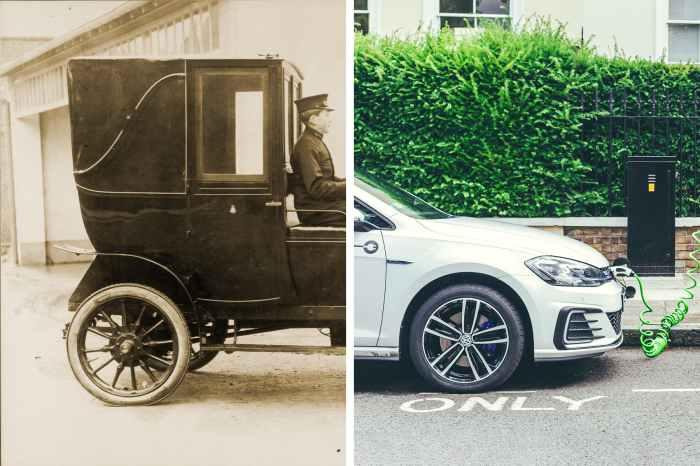
 Lithium battery powered cars were first sold in the U.S. in 2008, roughly 110 years after their gas-powered predecessors debuted on American roads.
Located at the western edge of Massachusetts, Berkshire County is today, as it has always been, a popular place to spend the summer. Banded by Williamstown in the north and Sheffield in the south, the region’s farm and conservation lands conjure up a bygone era, even as the appearance of modern cars and trucks on its roads reminds us of the here and now.
Not surprisingly, I’ve noticed firsthand that electric vehicles from Tesla, Ford, Rivian, and others have crept their way into the Berkshire countryside. EVs currently account for less than seven percent of new car purchases in the U.S.—up from just 2% in 2020. But, thus far, they are embraced primarily by early adopters like those in the Berkshires.
As it turns out, this trend was also true of the Berkshires in the early years of the first automobile revolution. More than 230 manufacturers—including Knox Automobile, Stevens-Duryea, the Packard Motor Company, Olds Motor Works, the Henry Ford Company, and Mercedes Simplex—tested their autos on the roads of Berkshire County in the first 15 years of the 1900s, according to historian Bernard A. Drew. In his insightful study of the early automobile industry, Well Wheeled: How Cortlandt Field Bishop, Marguerite Westinghouse, Alden Sampson II and Gilded Age Lenox Cottagers Fueled the Brass Era of American Automobiling, Drew, himself a Berkshire resident, reaches back in time to the turn of the 20th century, when the barriers to enter the car business were much lower than they are today. Small teams of talented engineers brought their early prototypes to the road, and the well-to-do assumed the risk of patronizing their efforts.
During that period, many of the well-heeled luminaries of the Gilded Age, such as the Sloanes, Morgans, Whartons, and Vanderbilts, spent their summers in the county. Unconstrained by speed limits and licenses, these early auto enthusiasts provide a glimpse into the challenge of moving the first fleet of automobiles into the mainstream.
Edith Wharton, who was among the most successful authors of the era and a Berkshire aristocrat, was also fascinated by the automobile. While taking a break from writing the next chapter of The Age of Innocence, or pondering the plot line for Ethan Frome, she could be seen behind the wheel of her single-cylinder, 10 horsepower 1904 Pope-Hartford, her 24-horsepower Panhard, or one of her many other cars. But she lamented their lack of reliability and her frequent visits to the local mechanic. “One set out on a 10-mile run with more apprehension than would now attend a journey across Africa,” she observed. There was, however, an “inexhaustible delight in penetrating to the remoter parts of Massachusetts” from behind the wheel.
It wasn’t until Ford launched the Model T in 1908 that the automobile became easier to operate—it introduced a simpler 2-speed manual gearbox—and became affordable for many, thanks to mass production. Model T annual sales increased from 10,000 in its debut year to more than 300,000 by 1914.
As was the case during the first automobile revolution, early EV models from Tesla, Porsche, and BMW were typically priced in excess of $80,000, and embraced primarily by well-heeled auto enthusiasts. But in just 15 years, the market is already entering its Model T era: EVs have begun to close the price gap with gas-powered cars. According to Cox Automotive the average EV is priced at $6,200 above the average price of a gasoline powered car. The gap would be considerably narrower, but for the cancellation of EV tax credits enacted under the Affordable Care Act.
Undeniably, more is needed to appeal to those still reluctant to take the EV plunge. Faster charging, greater availability of public charging stations, longer driving range, better cold weather performance, as well as even more affordable models will help to close the gap. Advances in autonomous driving will also give EVs another leg up over gas-powered cars.
While the Model T revolutionized personal transportation in the U.S., the horse and buggy was still a common mode of transportation through the Great Depression, particularly in rural areas. It took roughly 30 years after their commercial debut for autos to become ubiquitous on American roadways.
The U.S. is less than two decades into the EV revolution. There is still plenty of time for EVs to mature and demonstrate their advantages over the internal combustion engine created more than one hundred years ago.
Please note that an earlier version of this Op-Ed, written by Ben Z. Rose, president of Battle Road Research, appeared in Barron’s.
IMAGE CREDIT: ILLUSTRATION BY BARRON’S; GETTY (1), DREAMSTIME (1)
Competition Heating Up in Pickup Trucks
Rivian established a first mover advantage in the electric pickup truck market when it launched the R1T in 2021. Having won the coveted Motor Trend Truck of the Year award for 2022, Rivian, we believe, held the market share lead in EV pickup trucks as of the end of 2022.
Fresh on the heels of having won the Motor Trend Truck of the Year for 2023, Ford announced on January 5th that it has sold 15,617 F-150 Lightning trucks since the vehicle was unveiled to customers in May of last year. Ford has not so quietly been claiming that in each of the last two months it has sold more EV pickups than any other manufacturer.
By the end of Q1 2023, it is likely that Ford will pass Rivian to become the overall leader in electric pickup sales in the United States. This is not necessarily surprising, as Ford’s classic F-150 has been the best-selling truck in the United States for 46 consecutive years. Importantly, Ford offers the F-150 in multiple model variants that range in price from $40K to $90K. And Ford has many years of brand equity from which to draw. Moreover, while both Rivian and Ford are relatively inexperienced at building EVs, Ford has a demonstrated ability to produce vehicles in large volumes—something that Rivian has struggled with.
Another headwind facing Rivian is the inevitable launch of Tesla’s Cybertruck. To be clear, the Cybertruck is way behind schedule, relative to original estimates provided by Tesla, but it now appears that limited production will begin this summer. Rather than go head-to-head against Rivian and Ford in the market for conventional-looking EV pickup trucks, Tesla is taking a risk with a unique body style that is sure to electrify some, yet conceivably turn-off others. The angular, space-age body of the Cybertruck is equipped to handle any type of terrain, will supposedly feature a bullet-proof body, and will be manufactured with a unique mix of light-weight aluminum and ultra-hard 30x cold-rolled stainless steel.
From what we can gather, fly-over drone footage available over the Internet of Tesla’s Gigafactory in Texas revealed the recent delivery of at least part of a 9,000-ton Giga Press, which will be used to cast aluminum parts in the first production run. Elon Musk has said the Cybertruck, when available, will be the car he drives to work in Austin. The Cybertruck has the potential to put a freeze on the electric pickup truck market, as consumers will be curious to learn more about it before purchasing a rival vehicle. This is especially true for prospective Rivian buyers who desire an elite luxury pickup truck. While a case can be made that the R1T and Cybertruck may ultimately appeal to different buyers, it is likely that consumers who are interested in the R1T would also consider the Cybertruck for similar reasons. Could this be part of the reason why Rivian stopped disclosing its backlog?